Example:
Messages are sent into the queue by Application A and they are processed by Application B. If Application B fails, Application A doesn’t experience any disruption. Messages being sent can still be sent to the queue and will remain there until they are eventually processed.
This is loosely coupled. This is what we strive to achieve with architectures on AWS. And this brings me to two AWS services that can assist in this regard. Amazon Simple Queue Service or SQS and Amazon Simple Notification Service or SNS. But before I dive into those two services, let me just order a to-go coffee on our cafe website. Done. All right, well, that’s great. I should get a message when that order is ready.
First up, let’s discuss Amazon SQS. SQS allows you to send, store, and receive messages between software components at any volume. This is without losing messages or requiring other services to be available. Think of messages as our coffee orders and the order board as an SQS queue. Messages have the person’s name, coffee order, and time they ordered. The data contained within a message is called a payload, and it’s protected until delivery. SQS queues are where messages are placed until they are processed. And AWS manages the underlying infrastructure for you to host those queues. These scale automatically, are reliable, and are easy to configure and use.
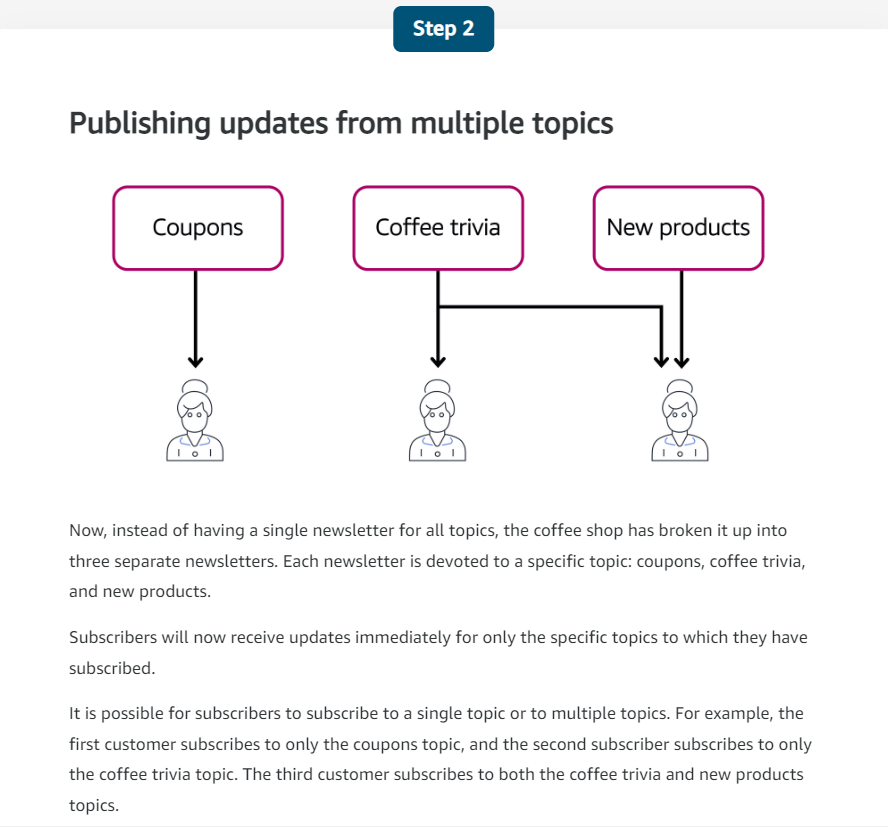
Now, Amazon SNS is similar in that it is used to send out messages to services, but it can also send out notifications to end users. It does this in a different way called a publish/subscribe or pub/sub model. This means that you can create something called an SNS topic which is just a channel for messages to be delivered. You then configure subscribers to that topic and finally publish messages for those subscribers. In practice, that means you can send one message to a topic which will then fan out to all the subscribers in a single go. These subscribers can also be endpoints such as SQS queues, AWS Lambda functions, and HTTPS or HTTP web hooks.
Additionally, SNS can be used to fan out notifications to end users using mobile push, SMS, and email. Taking this back to our coffee shop, we could send out a notification when a customer’s order is ready. This could be a simple SMS to let them know to pick it up or even a mobile push.
In fact, it looks like my phone just received a message. Looks like my order is ready. See you soon.

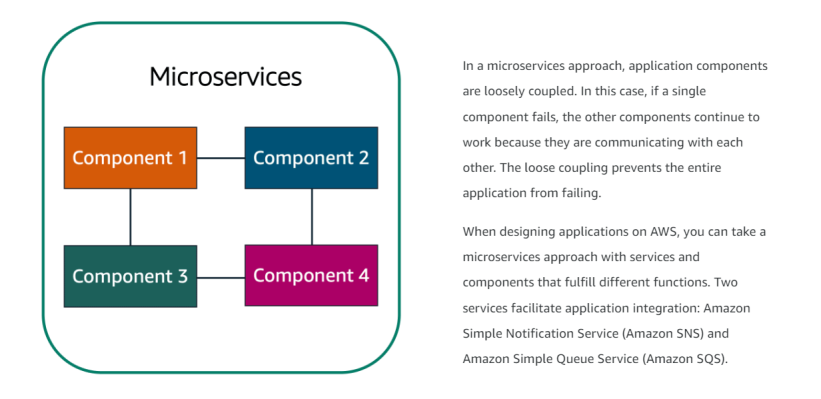
To help maintain application availability when a single component fails, you can design your application through a microservices approach.
Amazon Simple Notification Service (Amazon SNS)
Amazon Simple Notification Service (Amazon SNS) is a publish/subscribe service. Using Amazon SNS topics, a publisher publishes messages to subscribers. This is similar to the coffee shop; the cashier provides coffee orders to the barista who makes the drinks.