What is Data?
In simple words data can be fats related to any object for example – your age, job, house number, contact number, name, place or some data related to you.
What is Database?
Database is systematic Collection of data database support storage and manipulation of data.
For example Facebook telecom companies amazon.com
What is DBMS?
DBMS is a collection of programs which enable it’s user to access database manipulate data reporting or representation of data.
Types of DBMS
- Hierarchical
- Network
- Relational
- Object oriented
Relational Database
- A relational database is data structure that allows you to link information from different tables are different types of data bucket.
- Tables are related to each other.
- All fields must be filled.
- Best Suited for OLTP (online transaction processing).
- Relational DB – MY SQL, Oracle DBMS, IBM DB2.
- A role of a table is also called record it contents the specific information of each individual entry in the table.
- Each table has its own primary key
- A schema is used to strictly defines tables column index and relation between tables.
- Relational DB are usually used in Enterprises application or scenario.
- Exception in MY SQL which is used for web application
Common application for MY SQL include PHP and Java based web applications that requires a database storage backend for example JOOMLA.
- Cannot Scale – Out Horizontally.
- Virtually all Relational DB uses SQL.
In a relational database, data is stored in a way that relates it to other pieces of data.
An example of a relational database might be the coffee shop’s inventory management system. Each record in the database would include data for a single item, such as product name, size, price, and so on.
Relational databases uses structured query language (SQL)to store and query data. This approach allows data to be stored in an easily understandable, consistent, and scalable way. For example, the coffee shop owners can write a SQL query to identify all the customers whose most frequently purchased drink is a medium latte.
Example of data in a relational database:
| ID | Product name | Size | Price |
| 1 | Medium roast ground coffee | 12 oz. | $5.30 |
| 2 | Dark roast ground coffee | 20 oz. | $9.27 |
Amazon Relational Database Service
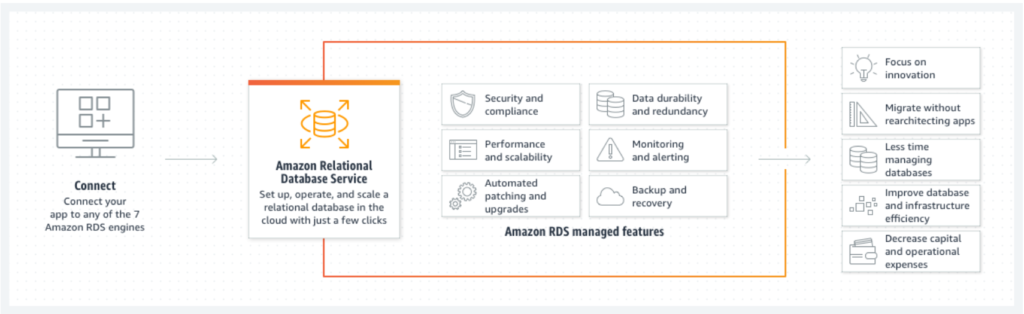
Amazon Relational Database Service (Amazon RDS)is a service that enables you to run relational databases in the AWS Cloud.
Amazon RDS is a managed service that automates tasks such as hardware provisioning, database setup, patching, and backups. With these capabilities, you can spend less time completing administrative tasks and more time using data to innovate your applications. You can integrate Amazon RDS with other services to fulfil your business and operational needs, such as using AWS Lambda to query your database from a serverless application.
Amazon RDS provides a number of different security options. Many Amazon RDS database engines offer encryption at rest (protecting data while it is stored) and encryption in transit (protecting data while it is being sent and received).
Amazon RDS database engines
Amazon RDS is available on six database engines, which optimize for memory, performance, or input/output (I/O). Supported database engines include:
- Amazon Aurora
- PostgreSQL
- MySQL
- MariaDB
- Oracle Database
- Microsoft SQL Server
